Published on: January 4, 2026
written by Kiomye Thompson
–
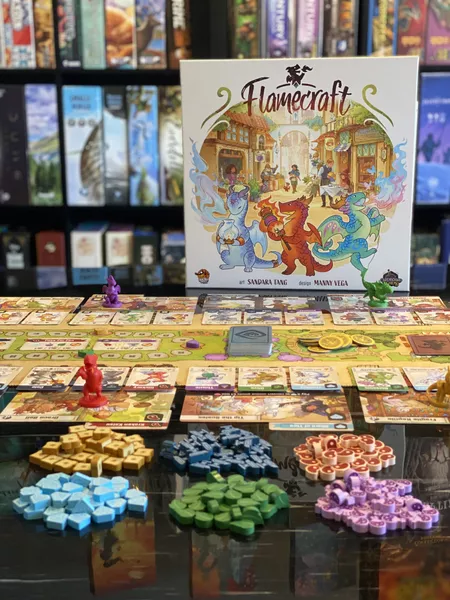
I adore dragons, and I don’t believe I’m alone in that sentiment. If you’re also a connoisseur of fantasy, whimsy, and most importantly, dragons, then I think you’ll enjoy this month’s highlighted board game: Flamecraft, published by Cardboard Alchemy. If you’ve read any of my other reviews, you’ll know that Critter Kitchen, from the same publisher, is what originally kick-started Rolling Reviews and our monthly shop board game demos. Because of that, Cardboard Alchemy holds a bit of a special place in my heart and Flamecraft absolutely lives up to that standard.
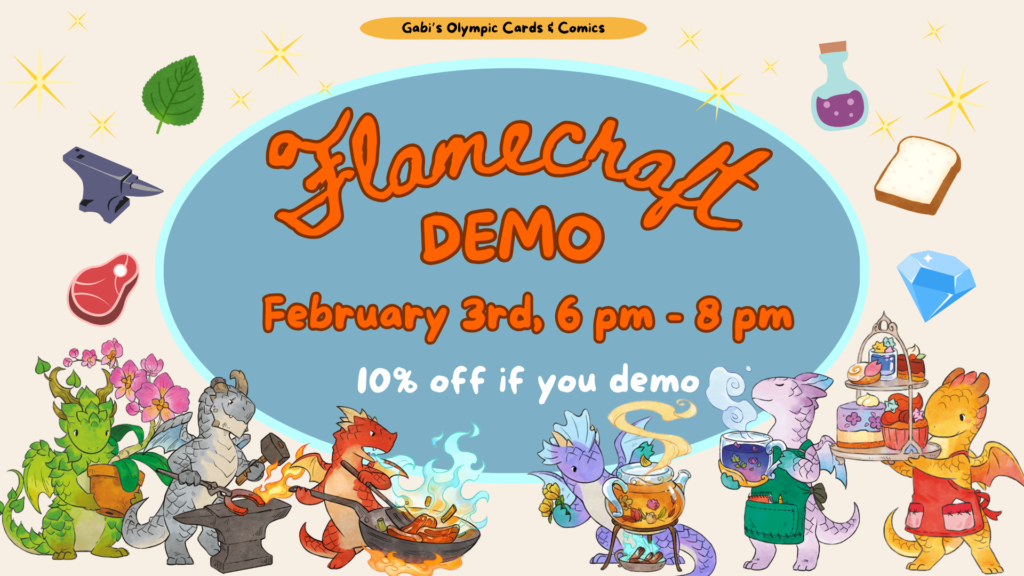
At its core, Flamecraft is a worker placement game about sending your dragon engineers around a growing town, helping local shops thrive, and earning the most reputation by the end of the game. If cozy art, approachable strategy, or thoughtfully designed worker placement games appeal to you, I highly recommend checking out our Flamecraft demo on February 3rd from 6–8pm.
–
–
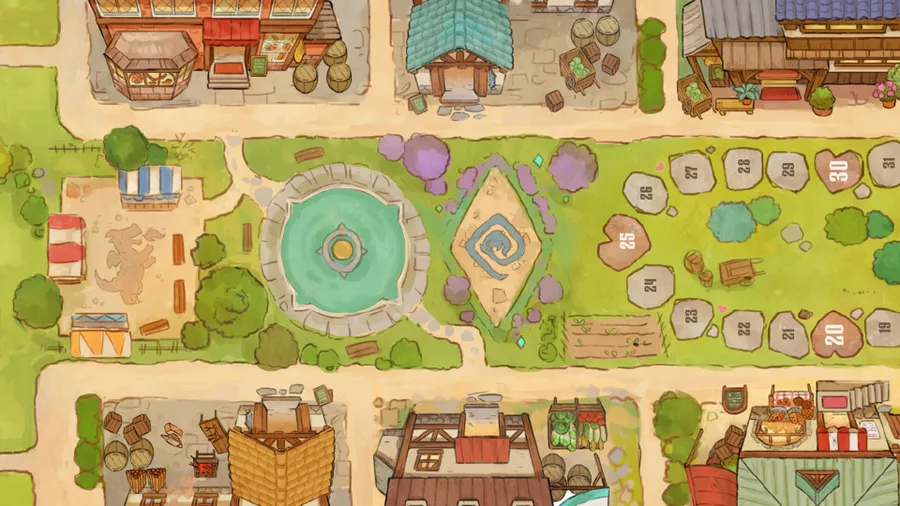
In Flamecraft, “worker placement” means you’ll be moving your single dragon token from shop to shop, choosing how to spend your turn. Each shop produces different resources: bread, meat, iron, leaves, potions, or gems and deciding where to go (and when) is the heart of the game. You can’t visit the same shop twice in a row, and if you visit a shop that another player is already at, you’ll need to give them a small gift. This keeps the game moving and creates gentle interaction without ever feeling punishing.
On your turn, you’ll always take one of two actions: gather or enchant.
When you gather, you collect the resources that shop produces and can place an artisan dragon from your hand into that shop. These dragons “work” there permanently, improving the shop and granting special abilities when the shop is fired up later. There are six types of artisan dragons, each with their own strengths. For example, some help you draw more dragons, others give flexible resources, and some even turn gifting into victory points. Choosing when to place dragons, and where, becomes a surprisingly meaningful decision.
The second action, enchanting, is where most of your reputation points come from. Enchantments require specific combinations of resources, and interestingly, they don’t usually match the shop you’re enchanting. That means you’ll need to visit a variety of shops to collect what you need. When you enchant a shop, you score reputation and get to “fire up” every dragon working there, triggering all of their abilities at once. These turns often feel explosive and deeply satisfying without becoming overwhelming.
In addition to enchantments, you’ll also score points through special dragons, called fancy dragons. These come in two types: Sun dragons, which score during the game if you meet their condition, and Moon dragons, which score at the very end as hidden bonuses. Think of them as long-term goals that gently nudge your strategy. While enchantments are the primary way to earn reputation, these special dragons can absolutely swing the game and sometimes right at the last moment.
One of the things I enjoyed most about Flamecraft is that every turn feels meaningful. Even when I wasn’t entirely sure what my long-term plan was early on, I never felt like I wasted a turn. That sense of steady progress makes the entire experience feel rewarding and welcoming, especially for newer players.
Another pleasant surprise was the game’s tone. While Flamecraft is competitive, it also creates a strong sense of shared growth. As new shops are added and artisan dragons fill the town, it genuinely feels like everyone is building this cozy little community together. You’re competing for reputation, but you’re also collectively making the town more vibrant and efficient, which is a really charming dynamic.
–
Visually, Flamecraft deserves special praise. The art by Sandara Tang is warm, expressive, and full of personality. Every dragon has its own name and illustration, every shop is packed with visual jokes and puns, and the overall presentation feels inclusive, joyful, and full of life. It’s the kind of game that immediately draws people in just by being on the table.
If you’re looking for a cozy yet strategic board game, I can’t recommend Flamecraft enough. It strikes a lovely balance: deep enough to reward planning and efficiency, but never so complicated that it feels intimidating. It’s a great fit for families, casual players, and experienced tabletop gamers alike.
I also want to mention that if the concept or art direction of Flamecraft appeals to you, there’s even more to explore. Cardboard Alchemy recently released Flamecraft Duals, a two-player-only, travel-friendly puzzle game. It leans more into pattern matching and spatial reasoning, and feels reminiscent of games like Calico or Harmonies, both of which I’ve reviewed previously.
On top of that, there’s a brand-new expansion: Flamecraft: Dragons, Dragons & Dragons. This expansion adds a ton of fresh content, including new Hydragons with unique abilities, a new starter shop, companion and adventurer dragons, upscale enchantments, and even a new neoprene play mat variant. It introduces new ways to play while still preserving the cozy, welcoming feel of the base game.
If any of this sounds like it might be up your alley, come join us on February 3rd for our open demo night. You’ll be able to try the base game, Flamecraft Duals, and the new expansion .and if you end up enjoying it, you’ll get 10% off your purchase that day just for demoing.
Whether you’re here for the strategy, the dragons, or just the vibes, Flamecraft is a warm, delightful experience and one I’m always happy to get back to the table.
–
–