Published on: March 1, 2026
written by Kiomye Thompson
–
For this month’s Rolling Review, I wanted to shine a spotlight on two titles that beautifully capture nature and cozy vibes: River Valley Glassworks from Allplay and Cozy Stickerville from Unexpected Games. Both games create inviting, relaxed experiences, but they do so in completely different ways, one through satisfying tactical play and the other through collaborative storytelling.
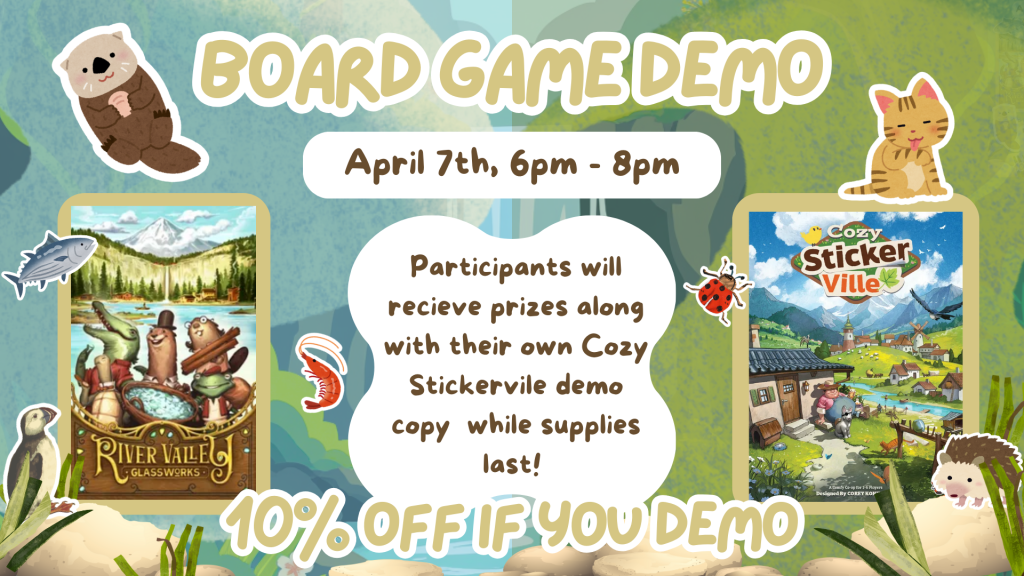
On April 7th from 6–8pm at Gabi’s Olympic Cards & Comics, I’ll be hosting a demo of both titles. Players who participate in River Valley Glassworks will receive a small piece of sea glass to take home, and those who try Cozy Stickerville will receive their own demo village board to admire the tiny town they’ve created. Supplies are limited, so I recommend arriving early.
–
–
River Valley
We’ll begin with River Valley Glassworks, designed by Ben Pinchback, Matt Riddle, and Adam Hill, with artwork by Matt Paquette & Co. It plays one to five players in under thirty minutes and has quickly become one of the easiest games for me to get to the table. In the short week that I’ve owned it, I’ve already played close to ten times, which says everything about how addictive and approachable it is.
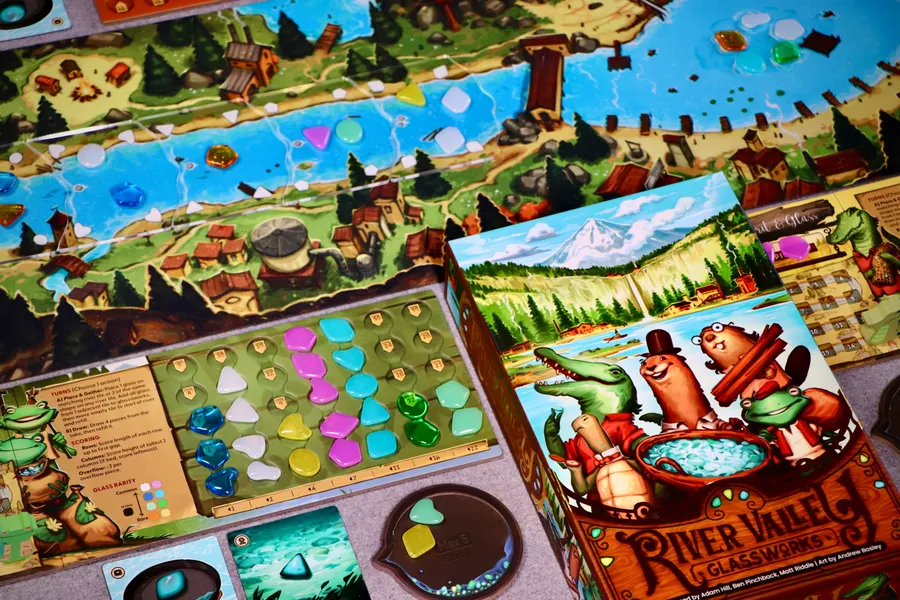
In River Valley Glassworks, players collect colorful pieces of sea glass drifting down a shared river. On your turn, you place a piece from your satchel into the river, following the shape requirements on the tiles, and then collect all of the glass from an adjacent tile. The system is simple, but it creates a quiet tension. Collect too conservatively and you may fall behind, but grab too much and you risk overflow. Any extra pieces that spill over become permanent negative points, forcing you to strike a careful balance between ambition and restraint.
What I love most is the subtle sense of shared space. While players are competing, everyone contributes to the same river. Each turn feels like both taking and giving, which creates an atmosphere that is competitive without ever feeling cutthroat.
I’ve now played at four players, two players, and solo, and it shines at every count. My family, who tends to shy away from heavier games, immediately enjoyed it. It also made for a wonderful date night game, quick to learn, satisfying to play, and easy to replay.
The solo mode is especially charming. You choose an animal opponent with its own personality and mechanical twist. In my first game, I faced Otter Snugs, who automatically collected glass from the fullest river tile after each of my turns. As certain milestones were reached on the otter’s board, new effects triggered, keeping the challenge dynamic. I lost by just three points, but it was one of those losses that made me want to reset the board immediately and try again.
The components are soft and whimsical, with thoughtfully designed glass pieces that feel delightful in hand. Everything fits beautifully back into the box. My only regret is not purchasing the deluxe edition, not because the standard copy isn’t lovely, but because I ended up loving the game enough to want the upgraded components. In 2024, River Valley Glassworks was even nominated for Best Casual Game by Board Game Quest, a title that truly suits it. It’s quickly become one of my favorite light games, and I genuinely can’t recommend it highly enough.
–
–
Switching gears, Cozy Stickerville offers a completely different, but equally cozy experience, as you may have figured already from the name of the game. Published by Unexpected Games, it plays one to six players, is best at two, runs around thirty minutes per session, and is recommended for ages eight and up. Although I’m fairly new to legacy games, this has been the most welcoming and approachable one I’ve tried so far.
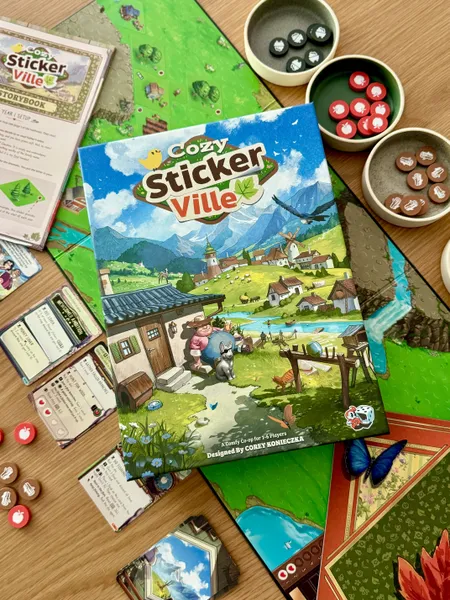
For anyone unfamiliar, a legacy game unfolds over multiple sessions, with player choices permanently changing the board and story. Many legacy titles are sprawling, complex adventures, but Cozy Stickerville takes a lighter approach. It feels more like a choose-your-own-adventure story brought to life with stickers and a shared village map.
The structure is refreshingly simple. Each round represents a “year,” and over ten years, players draw event cards and make decisions that shape their town’s development. Every choice matters, potentially unlocking new story beats or steering the village toward one of several possible endings. Resource management adds an extra layer of consideration; wood, food, and money must be carefully managed, or consequences may follow.
What truly made this game special for me was the experience around the table. There’s something surprisingly satisfying about physically placing stickers onto the board. My family and I found ourselves deep in debate over where buildings should go, which villagers to prioritize, and most heated of all, flower placement. Even during disagreements, the game brought us together.
We played over the course of three weeks, meeting every Friday to progress through a few years at a time. Between sessions, we talked about the village constantly, speculating about what might happen next. That sense of anticipation made the experience feel bigger than just the time we spent playing. Now that we’ve completed one full campaign, there’s an entirely blank board on the reverse side waiting for a different story to unfold.
Both of these games capture cozy gaming in their own way. River Valley Glassworks delivers quick, colorful, and satisfying tactical play wrapped in a calming aesthetic. Cozy Stickerville offers a gentle legacy journey centered on shared choices and storytelling. Together, they perfectly embody the calm, nature-inspired atmosphere I wanted to celebrate this month.
I hope you’ll join me on April 7th to experience them firsthand.
–
–
–